
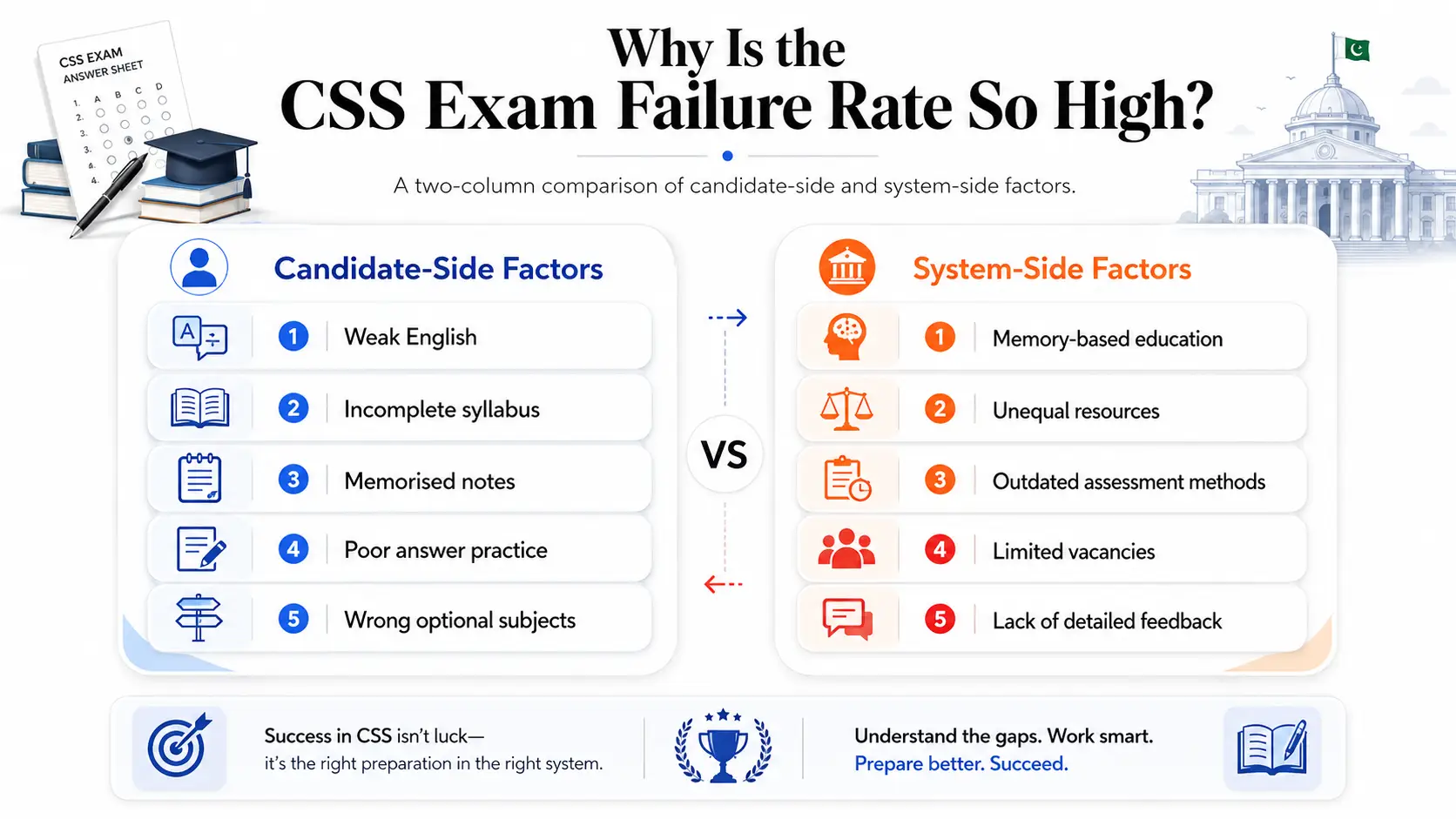
Thousands of graduates compete for a limited number of positions in the Central Superior Services every year, and only a small share reach the final stage. That's produced a widely repeated headline about the CSS exam failure rate: 97 to 98% of candidates fail. The number isn't wrong, exactly, but it flattens several distinct groups into one figure, and that flattening hides the real question. Are candidates failing because they're poorly prepared, or does the exam system itself need work? The FPSC's own results for CSS 2025 answer both questions at once, once you read them carefully.
Why the "97–98% fail" headline is misleading
That figure usually gets calculated against total applicants, somewhere between 25,000 and 30,000 people for CSS 2025, according to the government's own written reply to the National Assembly. But a large share of applicants never sit the written papers at all, for reasons ranging from incomplete documentation to simply changing their mind. FPSC's actual appearance count for CSS 2025 was 12,792, meaning well under half of applicants ever faced a single exam paper.
From there, the numbers split further. Of the 12,792 who appeared, 355 passed the written stage, a 2.77% pass rate. After viva voce, 342 candidates qualified overall, which works out to 2.67%, since a few written-stage passers don't clear the interview. Of those 342, only 170 were recommended for appointment, because the number of available vacancies was smaller than the number of successful candidates. Four different numbers, four different denominators, and each one describes something real. None of them alone is "the" CSS failure rate.
Figures reflect the official CSS 2025 result, announced 30 April 2026. Applicant count rounded from FPSC's National Assembly reply of 25,000–30,000.
Competition begins before the written exam
With roughly 125 to 133 applicants competing for each available vacancy, the low final selection rate is partly built into the recruitment structure itself. Even a significant improvement in candidate performance across the board wouldn't create enough positions for every capable aspirant, since FPSC recruits for a fixed 200 to 225 vacancies a year against tens of thousands of applications. That said, competition alone doesn't explain why so many individual candidates fail specific written papers rather than simply missing the cutoff by a narrow margin.
What the government says about the failure rate
The government's own explanation, given in a written reply to the National Assembly and reported by Dawn's Kalbe Ali on 17 May 2026, places considerable responsibility on candidate preparation. The reply identified weak academic foundations, poor comprehension, inadequate analytical skills and ineffective written expression as major reasons for failure, with examiners reportedly finding many answers below the standard expected from graduates. Candidates were said to struggle with building coherent arguments, understanding what a question actually demanded, and presenting ideas in logical sequence.
Meeting eligibility isn't the same as being ready
The formal CSS exam eligibility criteria determine who may compete, not whether that person can analyse policy questions, write a persuasive essay, or complete twelve demanding papers under exam conditions. A university degree provides eligibility. Competitive readiness requires broader reading, regular writing practice, current-affairs awareness, and the ability to connect evidence to an argument, none of which the eligibility bar tests directly.
Why the English papers remain a major barrier
The government's reply singled out English Essay and English Précis and Composition as major failure areas, citing weak academic backgrounds, limited analytical ability and an inadequate understanding of essay topics. English isn't simply another compulsory subject on the CSS syllabus; it shapes performance in Current Affairs, Pakistan Affairs, optional subjects and the viva, since candidates have to explain complex ideas clearly across every stage.
A candidate can understand an issue and still lose marks when the answer lacks structure. Memorised introductions, decorative vocabulary and long quotations don't rescue an answer that avoids the actual question, because the exam rewards relevance over the appearance of knowledge.
Is the English paper measuring the right skills?
Candidate weakness is only one side of this. In a January 2026 analysis for Dawn EOS, educationist Abbas Hussain criticised the design of the English Précis and Composition paper directly, arguing that parts of it still lean on isolated vocabulary and decontextualised exercises rather than practical communication. This is an informed opinion, not an official FPSC finding, but it raises a real policy question. Civil servants summarise reports, prepare briefings and communicate decisions for a living; an effective exam should test those abilities as directly as it can.
These two positions aren't actually in conflict. Candidates can be underprepared while parts of the exam also need modernising. Treating this as an either-or choice avoids the harder, more useful question: does the current design measure what the job actually requires?
Does Pakistan's education system prepare CSS candidates?
Much of the low pass rate reflects weaknesses that start long before anyone opens the CSS syllabus. University exams often reward reproducing lecture notes, while the CSS exam expects candidates to compare ideas, evaluate policy and build an independent argument. That shift from memory-based learning to analytical competition is a hard one, especially when candidates only discover the gap after graduating.
Not every aspirant starts from the same position, either. Differences in schooling, library access, English-language instruction and teacher quality shape performance well before the exam, and candidates from under-resourced areas can have real ability but still need more time to close language and academic gaps. This connects to the ongoing debate about the CSS age limit and attempt count, but raising either alone wouldn't fix uneven university instruction; that requires structural reform in education itself.
Is the CSS syllabus still fit for purpose?
FPSC's reply confirmed the CSS syllabus, last revised in 2016, is under review, with the Civil Services Reforms Committee examining the broader exam structure. That review is overdue in one sense: public administration now runs through digital governance, climate risk, urbanisation, AI policy and rapidly shifting international conditions that a decade-old syllabus wasn't built around.
Review doesn't have to mean lowering standards. Questions can stay demanding while testing policy analysis, evidence use and clear communication more directly, and the same review should ask whether the current mix of compulsory and optional subjects actually identifies candidates who can learn, reason and make sound decisions across changing assignments, not just candidates who know the most facts.
Optional subjects and coaching academies
Optional-subject selection
- The government's reply flagged poor optional-subject choices as a contributing factor.
- Aspirants sometimes pick a subject because an academy calls it "high scoring," ignoring personal background and interest.
- No subject guarantees a score; marking patterns shift year to year.
Coaching academies
- Good academies provide structure, feedback and access to experienced teachers.
- The reply cited excessive reliance on academy notes as a factor in poor results.
- Standard notes can't reflect what each specific question is actually asking.
Past papers are useful for the same reason good academy guidance is useful, and dangerous for the same reason bad guidance is dangerous: they should reveal recurring question types and the expected level of analysis, not hand candidates a script to memorise. A sensible routine studies a topic from primary sources, checks it against relevant past questions, then writes timed answers in more than one form.
Candidate weakness or exam design: what really drives the CSS exam failure rate
Assigning all the responsibility to candidates would be unfair to the ones who prepared seriously and still ran into a paper that rewarded the wrong things. Blaming the exam for every failure ignores real evidence of selective study and weak written expression. The more accurate read is that responsibility is shared: candidates need to prepare seriously, universities need to strengthen analytical instruction, and FPSC needs to keep every paper transparent, relevant and well-designed.
What candidates can improve
- Complete the full syllabus instead of chasing predicted questions.
- Practise English writing throughout preparation, not just before the exam.
- Support arguments with evidence, examples and official reports.
- Choose optional subjects through honest self-assessment, not academy hype.
What FPSC and policymakers could review
- Publish clearer competency expectations for major written papers.
- Check whether examination tasks reflect current administrative work.
- Update the syllabus through transparent, expert-led consultation.
- Improve examiner training and consistency without lowering standards.
What's next for CSS 2026
FPSC issued a public notice on 4 August 2026 stating that written results for the CSS 2026 examination are expected in the first week of September 2026. Whatever the final pass rate turns out to be, the same denominator questions from this article will apply the moment headlines start circulating: fail of whom, out of how many, at which stage?
Related resources on CSS Bureau
Frequently asked questions
Is it true that 97–98% of CSS candidates fail?
That figure comes from measuring against total applicants, which includes many who never sat the written exam. Against actual appearers, FPSC's CSS 2025 result showed a 2.77% written-stage pass rate and a 2.67% final qualification rate, both of which describe a different, narrower group than "all applicants."
What's the biggest reason CSS candidates fail?
FPSC's own written reply to the National Assembly points to weak academic preparation, poor analytical skills and low comprehension as the leading factors, with English Essay and Précis and Composition as the specific papers most candidates struggle with.
Is the low pass rate about competition or exam design?
Both. Roughly 125 to 133 applicants compete for every vacancy, which guarantees a low pass rate regardless of paper design. Separately, critics like educationist Abbas Hussain argue parts of the English paper test rote vocabulary rather than applied communication skills. Neither explanation cancels out the other.
When will CSS 2026 results be announced?
FPSC's public notice from 4 August 2026 set the expected date for the first week of September 2026. Check fpsc.gov.pk directly for the confirmed date once it's closer.
Final editorial position
The CSS exam failure rate doesn't reduce to a single cause, and it definitely doesn't reduce to a single number. FPSC's own data correctly identifies inadequate preparation, poor comprehension and weak analytical thinking as major factors. At the same time, credible criticism of the English paper's design and the ongoing syllabus review show the exam itself deserves scrutiny too. Pakistan doesn't have to choose between reforming candidates and reforming the test; both are underway, and both matter. What candidates can control right now is preparation quality. What FPSC can control is transparency about what each paper actually measures.
Sources and verification
Facts in this article were checked directly against FPSC's official result and the underlying Dawn reporting rather than secondary summaries.